
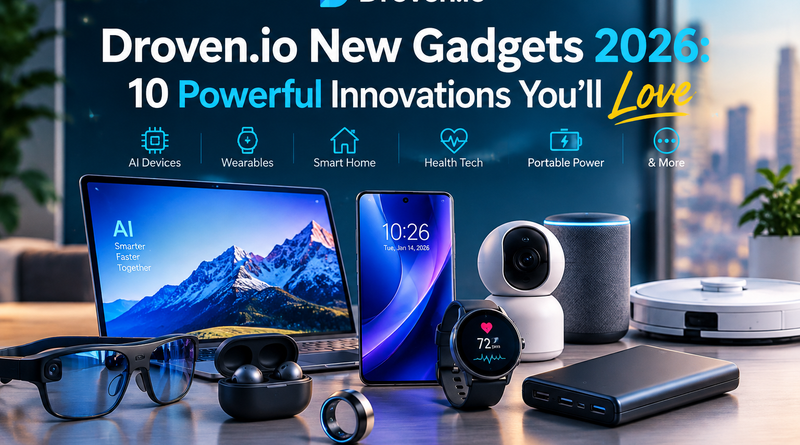
Droven.io New Gadgets 2026: 10 Smart Tech Trends
If you are searching for Droven.io new gadgets 2026, you are likely looking for the latest developments in smart devices, artificial intelligence, wearables, connected technology and next-generation consumer electronics. But there is an important distinction to make: Droven.io is better understood as a technology and review platform rather than a manufacturer with one official catalogue of “Droven” gadgets. Its technology coverage includes AI tools, software, gadgets and other digital innovations. This guide therefore focuses on the technology trends and device categories that are most relevant to the Droven.io new gadgets 2026 topic, while separating confirmed developments from general predictions.
What Is Droven.io New Gadgets 2026?
The phrase Droven.io new gadgets 2026 can sound like the name of a specific product range. However, available information from Droven.io shows a broader technology-review focus that includes AI tools, software and gadgets.
That distinction matters when researching new technology. A reader searching for the phrase may want to know what kinds of gadgets are becoming important in 2026, which technologies are genuinely useful and which products deserve closer attention.
The 2026 gadget market is particularly interesting because artificial intelligence is moving beyond traditional software. AI is increasingly being integrated into computers, glasses, wearables, smart-home products and other connected devices.
Instead of simply adding another app to a phone, manufacturers are increasingly building AI capabilities directly into hardware.
This creates a new type of gadget: a device that can understand context, process information, respond to natural-language requests and sometimes complete tasks with less direct input from the user.
Why 2026 Is an Important Year for New Gadgets
The consumer technology market is moving in several directions at once.
AI is becoming more closely integrated with hardware. Extended reality is developing beyond traditional virtual-reality headsets. Smart glasses are receiving renewed attention. Computers are increasingly designed around dedicated AI processing. Smart-home devices are becoming more connected, while health and fitness products continue to collect increasingly detailed data.
Google’s 2026 Android XR announcements provide a good example of this change. The company says its intelligent eyewear will offer both audio-only and display-based experiences, with features such as navigation, messaging, photography and translation.
At the same time, Qualcomm’s 2026 PC announcements show how AI processing is moving closer to the device itself. Its Snapdragon X2 platforms are designed around CPU, GPU and NPU processing for AI workloads, including capabilities that can run locally rather than relying entirely on the cloud.
These developments explain why the Droven.io new gadgets 2026 topic is broader than a simple list of products.
10 Smart Gadget Trends to Watch in 2026
1. AI Smart Glasses
AI smart glasses are one of the most visible technology trends of 2026.
Unlike conventional smart glasses that mainly focus on notifications or audio, newer AI-focused eyewear is designed to provide contextual assistance.
Google announced in May 2026 that its Android XR intelligent eyewear would include two major approaches: audio glasses that provide spoken assistance and display glasses that can show information directly in the user’s field of view.
Potential uses include:
- asking questions about something you can see
- receiving walking directions
- taking photos and videos
- handling calls and messages
- translating speech or written text
- interacting with phone applications
- receiving AI assistance without constantly reaching for a smartphone
The important development is not simply putting a camera on a pair of glasses.
The bigger change is the combination of cameras, microphones, speakers, displays and AI.
That combination allows the device to understand more of the user’s surroundings and provide assistance based on context.
However, smart glasses also raise important questions about privacy, battery life, comfort and social acceptance.
A camera-equipped device worn in public can affect not only the person using it but also people nearby. For this reason, privacy indicators, recording controls and clear user permissions will remain important.
2. AI-Powered Laptops and PCs
The personal computer is another major area of change.
For years, most AI services depended heavily on cloud computing. In 2026, manufacturers are increasingly combining traditional processors with dedicated neural processing units, or NPUs, to handle selected AI tasks directly on the computer.
Qualcomm’s Snapdragon X2 platform is one example. The company describes its latest PC platform as combining CPU, GPU and NPU resources to support AI workloads on the device while still allowing cloud services to be used when additional computing power is needed.
This approach can offer several advantages.
Local AI processing can reduce the need to send certain tasks to remote servers. It can also improve response times for supported workloads and potentially reduce dependence on a continuous internet connection.
For users, the practical benefits may include:
- faster AI-assisted workflows
- improved productivity tools
- local image and document processing
- better video and creative applications
- AI-assisted communication
- more responsive computer assistants
However, buyers should not assume that every laptop carrying an “AI PC” label will automatically provide the same benefits.
The actual experience depends on the processor, operating system, applications and the AI features supported by the software.
3. Extended Reality and Spatial Computing
Extended reality, often shortened to XR, is moving into a broader stage.
Google’s Android XR platform is designed for both headsets and glasses. In 2026, Google has continued expanding the platform with features designed to make immersive computing more practical.
One interesting development is the ability to place applications within physical surroundings.
For example, users can position apps on walls and interact with virtual content while remaining aware of the physical environment. Google has also introduced features that allow users to see their real hands while interacting with virtual content.
This could make XR more useful for:
- work
- entertainment
- education
- training
- design
- gaming
- remote collaboration
The challenge remains comfort.
A headset can provide an impressive experience, but users may not want to wear a heavy device for several hours every day.
That is why the future of XR is likely to involve a mixture of headsets, lightweight glasses and other devices rather than one product replacing everything.
4. AI Wearables
Wearables have traditionally focused on fitness tracking, notifications and basic health measurements.
The next generation is increasingly focused on interpretation.
Instead of simply showing a number, AI-enabled wearables can potentially help users understand patterns in their data.
Examples include:
- sleep trends
- activity patterns
- heart-rate information
- exercise performance
- recovery indicators
- stress-related measurements
- personalized reminders
The value of these products will depend heavily on accuracy, software quality and how clearly information is presented.
Consumers should also remember that health-related wearable data is not automatically equivalent to medical diagnosis.
A smartwatch or smart ring can be useful for tracking trends, but users should not treat every consumer measurement as a clinical result.
5. Smart Rings and Compact Health Devices
Smart rings are another category worth watching.
Their biggest advantage is size.
A ring can remain on the user throughout the day and night without feeling as noticeable as a smartwatch.
Depending on the product, smart rings may monitor metrics such as movement, sleep and heart-related measurements.
The strongest reason to consider this category is convenience.
If a device is comfortable enough to wear consistently, it may collect more useful long-term information than a larger product that the user regularly removes.
But there is another side to the equation: subscriptions.
Before buying any health-focused wearable, check whether advanced insights require a monthly or annual membership.
The initial hardware price is only part of the total cost.
6. Smarter Home Devices
Smart-home technology is becoming less about controlling individual lights and more about connecting different parts of the home.
A modern smart-home ecosystem can include:
- lighting
- thermostats
- cameras
- doorbells
- speakers
- locks
- appliances
- energy monitors
- sensors
AI can make these systems easier to control because users can communicate with them more naturally.
Instead of remembering a particular command, a user may be able to describe what they want.
The real opportunity is automation.
A useful smart-home system should reduce repetitive work rather than create more settings to manage.
For example, automatically adjusting lighting, temperature or energy use can be more valuable than having another device that simply responds to a voice command.
7. Home Robotics
Home robotics is another area receiving increasing attention.
Robots are becoming more capable of sensing their surroundings and performing specific tasks.
However, consumers should be careful with exaggerated claims about fully autonomous humanoid robots.
The more practical near-term applications are often specialized.
These can include:
- robotic vacuum cleaners
- lawn-care robots
- security robots
- automated cleaning systems
- smart kitchen appliances
- specialized assistance devices
Specialized robots have one important advantage: they only need to solve a limited problem.
A robot designed specifically for floor cleaning does not need to understand every part of a home.
That makes the technology easier to deploy than a general-purpose machine expected to perform dozens of unrelated tasks.
8. Connected Audio Devices
Wireless earbuds and headphones are also becoming more intelligent.
Modern audio devices can include features such as:
- adaptive noise cancellation
- spatial audio
- voice assistants
- translation
- hearing-related features
- improved microphones
- device-to-device connectivity
The most interesting development is the integration of AI.
An earbud can become more than an audio player when it is connected to an intelligent assistant.
For example, a user could potentially ask a question, receive directions or interact with an AI service without taking out a phone.
Google’s 2026 Android XR eyewear announcements demonstrate how audio-based assistance can become part of wearable computing.
9. Portable AI Devices
Another trend is the development of smaller devices designed specifically for AI interaction.
The idea is simple: instead of opening an application, users interact directly with an assistant.
These products may include:
- AI voice devices
- portable assistants
- small translation devices
- AI-enabled recording tools
- smart productivity accessories
But this category requires caution.
A standalone AI device must offer a meaningful advantage over a smartphone.
If the same task can be completed more easily on a phone that the user already owns, the additional device may not provide enough value.
That is why the best portable AI gadgets will need to be genuinely convenient rather than simply novel.
10. Privacy-Focused Smart Technology
Privacy may become one of the most important gadget features of 2026.
As devices become more intelligent, they also process more information.
Depending on the product, that information may include:
- voice recordings
- photographs
- location
- health data
- contacts
- messages
- browsing activity
- information about the user’s surroundings
A device can therefore be technologically impressive while still being a poor choice from a privacy perspective.
Consumers should look for clear privacy policies, permission controls, security updates and understandable data-management options.
On-device AI can sometimes help by allowing certain processing to happen locally, although local processing does not automatically make a product completely private.
The important question is always:
What data does the device collect, where is it processed, how long is it stored, and who can access it?
What Makes a New Gadget Worth Buying?
A new gadget should solve a real problem.
That sounds obvious, but it is easy to forget when a product has impressive specifications.
Before buying, ask five basic questions.
Does it solve a problem I actually have?
If the answer is no, the product may become unnecessary clutter.
Will I use it regularly?
A gadget that is used every day can provide far more value than a device used twice because it looked interesting at launch.
Does it work with my existing devices?
Compatibility matters.
Check whether the gadget works with your phone, computer, operating system and other smart devices.
Does it require a subscription?
Some hardware becomes significantly more expensive when premium features require monthly payments.
Calculate the total cost over at least one or two years.
How long will it receive software updates?
Smart hardware depends on software.
A device with excellent specifications can become less useful if security updates and software support stop too soon.
AI Gadgets: What Buyers Should Check
AI is now one of the biggest selling points in consumer technology.
But the word “AI” alone does not tell you whether a product is useful.
Look for specific features.
A good product should explain what its AI actually does.
For example, does it summarize information? Translate speech? Recognize objects? Automate a task? Improve photography? Assist with writing? Process information locally?
The more specific the explanation, the easier it is to judge the value.
Be cautious about products that simply use AI as a marketing label without explaining the actual user benefit.
Privacy and Security in New Gadgets
Privacy should be considered before buying any connected device.
A camera-equipped gadget can capture images.
A microphone-equipped gadget can process conversations.
A location-enabled device can reveal where the user spends time.
A health wearable can collect highly personal information.
This does not mean consumers should avoid smart technology.
Instead, users should understand what they are accepting.
Before purchasing, check:
- privacy policy
- data collection settings
- microphone and camera permissions
- account security
- two-factor authentication
- software-update policy
- cloud-storage options
- data deletion options
The more sensitive the information handled by a device, the more important these checks become.
How to Choose the Right Gadget in 2026
The best gadget depends on the user.
For productivity
An AI-enabled laptop may make more sense than a standalone AI device because the computer is already central to the user’s workflow.
For travel
Smart glasses, translation tools and compact charging accessories may be more useful.
For fitness
A smartwatch or smart ring may be a better choice than a collection of separate tracking devices.
For entertainment
XR headsets, spatial audio products and smart displays can provide more value.
For smart homes
A reliable ecosystem with good compatibility may be more important than buying the newest individual device.
For privacy-conscious users
Look for products that provide strong permission controls and clear explanations of local versus cloud processing.
Are the Latest Gadgets Always Better?
No.
A newer device can have a faster processor or additional AI features, but that does not automatically make it a better purchase.
A mature product may offer:
- better reliability
- longer software support
- lower price
- stronger accessory compatibility
- better battery life
- more established apps
New technology is most valuable when it solves a problem that older technology cannot solve efficiently.
That is why consumers should compare actual benefits rather than simply comparing release dates.
Droven.io New Gadgets 2026: What to Expect Next
The direction of consumer technology suggests that gadgets will become increasingly connected to AI services.
Smart glasses are likely to become more capable.
AI PCs will continue to improve local processing.
XR devices will become more practical.
Wearables will continue collecting and interpreting personal data.
Smart homes will become more automated.
At the same time, the industry will face difficult questions about privacy, security and digital dependence.
Google’s continued development of Android XR shows how quickly AI assistants are moving into physical devices. Its 2026 announcements include intelligent eyewear designed to provide hands-free assistance and XR features designed for more natural interaction.
Meanwhile, new AI PC platforms show that the shift is also happening inside conventional computers.
The next stage of gadgets will therefore not simply be about smaller, faster or more powerful hardware.
It will be about how naturally technology fits into everyday life. Crackstube
Frequently Asked Questions
What are Droven.io new gadgets 2026?
Droven.io new gadgets 2026 is best treated as a search topic around new consumer technology, gadgets, AI devices and emerging digital innovations covered in the broader technology-review context of Droven.io. It should not be interpreted as the official name of one confirmed Droven product catalogue.
Does Droven.io manufacture its own gadgets?
Droven.io’s available technology coverage presents it as a platform covering technology, AI tools, software and gadgets. It should not automatically be described as the manufacturer of every gadget discussed under the keyword.
What are the biggest gadget trends in 2026?
Major trends include AI smart glasses, AI PCs, XR devices, smart wearables, connected homes, robotics, intelligent audio devices and privacy-focused technology.
Are AI gadgets worth buying in 2026?
They can be, but the value depends on the actual feature and the user’s needs. Buyers should focus on practical benefits instead of purchasing a product simply because it includes an AI feature.
Are smart glasses useful in 2026?
Smart glasses are becoming more capable, particularly for hands-free assistance, navigation, photography, translation and AI interaction. Google’s 2026 Android XR plans demonstrate how these functions are moving toward mainstream consumer use.
What should I check before buying a new gadget?
Check compatibility, battery life, software support, privacy controls, security updates, subscription costs, repair options and whether the product solves a real problem.
Are smart-home devices safe?
They can be, but security depends on the manufacturer’s software, update policy, account protection and the user’s configuration. Always use strong passwords, available two-factor authentication and current firmware.
Should I buy a new gadget immediately after launch?
Not necessarily. Waiting can provide more real-world reviews, software updates and price information. If the gadget solves an important problem for you, however, an early purchase may make sense.
Final Verdict
The Droven.io new gadgets 2026 topic reflects a much larger change in consumer technology.
The most interesting gadgets of 2026 are not simply adding more specifications. They are becoming more intelligent, more connected and more aware of their surroundings.
AI smart glasses are bringing assistants closer to everyday life. AI PCs are moving more processing onto the device. XR headsets are becoming more practical. Wearables are becoming more sophisticated. Smart homes are becoming more automated, while privacy is becoming an increasingly important part of the buying decision.
The smartest approach is not to buy every new device.
Instead, identify the problem you want to solve, compare the available technology and consider the long-term cost.
A gadget that remains useful six months after purchase is more valuable than one that is exciting for six days.
That is the principle worth keeping in mind when exploring Droven.io new gadgets 2026 and the wider world of consumer technology.