
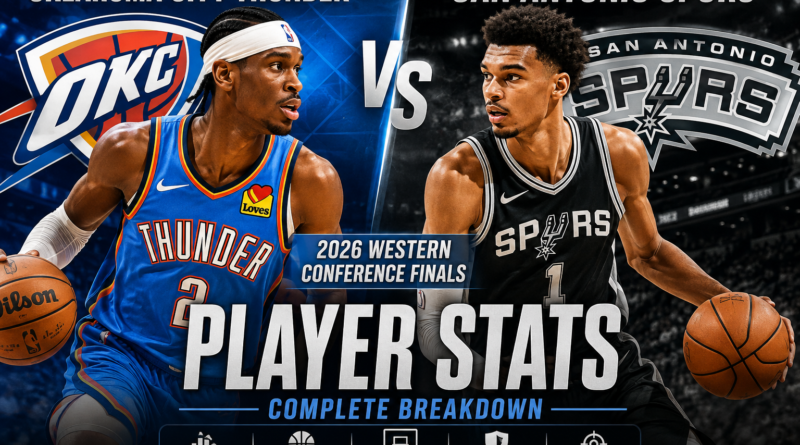
Oklahoma City Thunder vs San Antonio Spurs Match Player Stats: Complete Breakdown of the 2026 Western Conference Finals
The Oklahoma City Thunder vs San Antonio Spurs match player stats tell the story of one of the most competitive Western Conference playoff series of 2026. The two teams met in the Western Conference Finals, with Oklahoma City entering as the No. 1 seed after a 64-18 regular season and San Antonio finishing second in the West at 62-20. The series ultimately went the full seven games, with the Spurs winning Game 7 in Oklahoma City to advance to the NBA Finals.
For fans searching for Oklahoma City Thunder vs San Antonio Spurs match player stats, the 2026 Western Conference Finals provide plenty to examine. Shai Gilgeous-Alexander was Oklahoma City’s primary offensive engine, while Victor Wembanyama produced several outstanding performances for San Antonio. Around those two stars, players such as Chet Holmgren, Isaiah Hartenstein, Devin Vassell, Julian Champagnie, Stephon Castle, Alex Caruso, Jared McCain and Jaylin Williams played important roles at different stages of the series.
The matchup was particularly fascinating because both teams had different ways of creating advantages. Oklahoma City relied heavily on its defensive pressure, transition opportunities, star scoring and deep bench. San Antonio countered with Wembanyama’s interior presence, versatile guards, three-point shooting and length across the lineup. The final result was a seven-game series that featured huge individual performances, major momentum swings and several memorable statistical displays.
Oklahoma City Thunder vs San Antonio Spurs Match Result
The 2026 Western Conference Finals ended with the San Antonio Spurs winning the series 4-3. San Antonio won Game 7 by a score of 111-103 at Paycom Center in Oklahoma City on May 30, 2026. The Spurs led 32-25 after the opening quarter, while Oklahoma City responded in the second and third quarters before San Antonio closed the game strongly in the fourth.
The series was closely contested from the beginning. San Antonio won Game 1, 122-115, after two overtimes. Oklahoma City answered with a 122-113 victory in Game 2, then won Game 3 by 123-108 to take a 2-1 advantage. San Antonio responded with a dominant 103-82 victory in Game 4, while Oklahoma City won Game 5, 127-114. The Spurs then forced Game 7 by winning Game 6, 118-91, before completing the series with their 111-103 Game 7 victory.
That sequence makes the player statistics particularly important. Neither team controlled the entire series, and individual performances often determined which team won each game.
Game 3 Player Stats: Thunder 123, Spurs 108
Game 3 was one of the clearest examples of Oklahoma City’s depth changing the outcome of a playoff game. The Thunder defeated San Antonio 123-108 at the Frost Bank Center on May 22, taking a 2-1 series lead. Oklahoma City recovered from a 15-0 deficit at the beginning of the game and eventually took control behind its star guard and an exceptional bench performance.
Shai Gilgeous-Alexander led Oklahoma City with 26 points and 12 assists, shooting 6-of-17 from the field, 2-of-4 from three-point range and a perfect 12-of-12 from the free-throw line. His ability to control the offense while creating scoring opportunities for teammates was crucial after the Thunder fell behind early.
Jared McCain was another major contributor, scoring 24 points off the bench. Jaylin Williams added 18 points, while Alex Caruso scored 15. Cason Wallace contributed 11 points. The Thunder’s reserves scored an extraordinary 76 points, compared with just 23 bench points for San Antonio. That 53-point bench advantage was one of the defining statistics of the game.
Chet Holmgren finished with 14 points, three rebounds and one assist while shooting 5-of-7 from the field. Isaiah Hartenstein contributed five points, eight rebounds and four assists in the statistical breakdown. The Thunder therefore received meaningful production from multiple areas rather than depending entirely on Gilgeous-Alexander.
San Antonio’s leading scorer in Game 3 was Victor Wembanyama, who finished with 26 points, four rebounds, three assists, one steal and two blocks. Devin Vassell scored 20 points, De’Aaron Fox added 15, and Stephon Castle recorded 14 points and seven assists. Julian Champagnie finished with 10 points.
Despite strong individual performances, San Antonio struggled to match Oklahoma City’s overall depth. The Spurs shot 48.1% from the field and made 17 three-pointers, but the Thunder generated more balanced scoring and committed only 10 turnovers compared with 15 for San Antonio.
Shai Gilgeous-Alexander’s Impact on the Matchup
Shai Gilgeous-Alexander was central to the Oklahoma City Thunder vs San Antonio Spurs match player stats throughout the Western Conference Finals. His value was not limited to points. His ability to draw fouls, attack the paint, create mid-range shots and distribute the ball made him one of the most difficult players for San Antonio to contain.
Game 3 illustrates this perfectly. Gilgeous-Alexander scored 26 points while recording 12 assists, meaning he directly influenced a large portion of Oklahoma City’s offense. His perfect 12-for-12 performance at the free-throw line also gave the Thunder reliable scoring when the game became more physical.
His performance also demonstrated an important feature of Oklahoma City’s offense: the team did not necessarily need its star to score 40 points to win. When Gilgeous-Alexander attracted defensive attention, players such as McCain, Caruso and Jaylin Williams were able to exploit open opportunities.
That balance became increasingly important as the series progressed. San Antonio could concentrate defensive attention on Oklahoma City’s primary scorer, but doing so created opportunities for the Thunder’s supporting cast.
Victor Wembanyama’s Player Stats and Influence
Victor Wembanyama was arguably the most influential individual matchup problem in the series. His combination of size, shooting ability, rebounding and shot blocking forced Oklahoma City to make difficult decisions throughout the seven games.
His Game 1 performance was particularly spectacular. Wembanyama recorded 41 points and 24 rebounds as the Spurs defeated the Thunder 122-115 in double overtime. Dylan Harper added 24 points and seven steals in that game, while San Antonio’s ability to make plays during the extended finish proved decisive.
Wembanyama also produced 26 points, four rebounds, three assists, one steal and two blocks in Game 3. He shot 8-of-15 from the field, 2-of-5 from three-point range and 8-of-10 from the free-throw line.
His presence affected the game even when he was not scoring. Oklahoma City’s offensive players had to consider his ability to contest shots near the basket, while his shooting range could pull defenders away from the paint. This combination made him a unique challenge for the Thunder’s frontcourt.
The series also demonstrated that Wembanyama could influence a game through multiple statistical categories rather than simply scoring. Rebounds, blocks, assists and defensive attention all contributed to his overall impact.
Chet Holmgren vs. Victor Wembanyama
One of the most interesting individual battles in the series was the frontcourt matchup involving Chet Holmgren and Victor Wembanyama. Both players combine unusual height with perimeter skills, but they play within different offensive structures.
Holmgren’s ability to stretch the floor helped Oklahoma City maintain spacing around Gilgeous-Alexander. In Game 3, he shot 5-of-7 from the field and finished with 14 points.
Wembanyama had a larger scoring role for San Antonio and frequently served as the focal point of the Spurs’ half-court offense. His 41-point, 24-rebound performance in Game 1 demonstrated just how much pressure he could place on Oklahoma City’s defense.
The contrast between the two players was one of the tactical themes of the series. Oklahoma City needed Holmgren to contribute efficient scoring, rebounding and rim protection without disrupting its overall spacing. San Antonio needed Wembanyama to provide elite two-way production while handling enormous defensive responsibility.
Devin Vassell’s Contribution for San Antonio
Devin Vassell was another important name in the Oklahoma City Thunder vs San Antonio Spurs match player stats. His shooting ability gave San Antonio an additional perimeter scoring threat alongside Wembanyama.
In Game 3, Vassell scored 20 points, shooting 6-of-12 from the field, 3-of-6 from three-point range and 5-of-5 from the free-throw line. He also collected seven rebounds, two assists and four steals.
His four steals were especially valuable because San Antonio needed defensive plays to create transition opportunities. When Vassell was able to combine perimeter scoring with defensive activity, the Spurs became much more difficult to defend.
His performance also illustrates why the Thunder could not simply focus on Wembanyama. San Antonio had additional players capable of converting open shots and attacking defensive mistakes.
Stephon Castle and De’Aaron Fox
San Antonio’s backcourt featured another important statistical storyline. Stephon Castle combined scoring and playmaking, while De’Aaron Fox provided another experienced offensive creator.
In Game 3, Castle finished with 14 points, five rebounds and seven assists, along with one steal and two blocks. Fox scored 15 points, collected seven rebounds and produced six assists.
Their passing was important because Wembanyama’s effectiveness often depends on receiving the ball in advantageous positions. When San Antonio’s guards moved the ball efficiently, Oklahoma City’s defense had to cover multiple threats.
Fox also returned to the starting lineup in Game 3 after missing the previous two games. His presence gave San Antonio another ball handler and helped stabilize the offense.
Oklahoma City’s Bench Made a Major Difference
If one statistic best explains Oklahoma City’s Game 3 victory, it is bench scoring. The Thunder’s reserves produced 76 points, while San Antonio’s bench scored only 23. NBA.com described the 76 bench points as a franchise record and the highest total in an NBA Conference Finals game since 1970-71.
Jared McCain led that group with 24 points. Jaylin Williams added 18, Alex Caruso scored 15 and Cason Wallace contributed 11. This meant Oklahoma City had four major contributors outside its starting lineup.
The importance of bench scoring goes beyond the raw total. It allowed Gilgeous-Alexander to play his natural role instead of having to manufacture every possession himself. The reserves also kept Oklahoma City’s energy level high and helped the team recover from its disastrous 15-0 start.
For a playoff team, this kind of depth can be decisive. Opponents may successfully limit a star player for stretches, but it becomes much harder to win when several reserve players are simultaneously producing efficient offense.
The Importance of Three-Point Shooting
Three-point shooting was another major component of the matchup. Both teams had players capable of stretching defenses, but their results varied considerably from game to game.
In Game 3, San Antonio made 17 three-pointers, compared with 13 for Oklahoma City. However, the Thunder still won comfortably because it created advantages elsewhere. The Spurs shot 17-of-38 from three-point range, while Oklahoma City shot 13-of-41.
This is a useful reminder that three-point percentage alone does not determine the outcome of an NBA game. Oklahoma City compensated through free throws, bench scoring, ball movement and overall offensive balance.
Gilgeous-Alexander’s 12-for-12 free-throw shooting was particularly important. Free throws can become a major factor in playoff games because they allow a team to score without relying on field-goal attempts.
Rebounding and Ball Security
Rebounding and turnovers also help explain the statistical battle. In Game 3, San Antonio finished with 41 rebounds, compared with 37 for Oklahoma City. The Spurs therefore won the overall rebounding battle, but Oklahoma City still controlled the scoreboard.
The Thunder’s advantage came partly from taking better care of the basketball. Oklahoma City committed 10 turnovers, while San Antonio had 15. Five additional turnovers can create several extra possessions for the opposition, especially against a team that can score efficiently in transition.
The Thunder also recorded 29 assists compared with San Antonio’s 26. That relatively close number shows that both teams moved the ball effectively, but Oklahoma City received greater scoring production from its secondary players.
Game 4 Shows the Other Side of the Series
The 103-82 Game 4 victory for San Antonio provided a dramatic contrast to Game 3. The Spurs bounced back from their 123-108 defeat by limiting Oklahoma City to only 82 points.
That result highlighted how quickly the statistical story could change. The Thunder’s offense had been highly effective in Game 3, but San Antonio’s defense and overall control completely changed the complexion of the next contest.
Chet Holmgren finished Game 4 with 10 points and nine rebounds, while Oklahoma City struggled to produce the offensive efficiency it had displayed two nights earlier.
The game reinforced a central theme of the series: neither team could rely on a single formula. Each victory required adjustments in shot selection, defensive coverage, rebounding and pace.
Game 5: Shai Gilgeous-Alexander Leads the Thunder
Oklahoma City regained the advantage in Game 5 with a 127-114 victory on May 26. Shai Gilgeous-Alexander led the Thunder with 32 points and nine assists, while Alex Caruso contributed 22 points. Jared McCain scored 20 points in his first playoff start for Oklahoma City.
Chet Holmgren recorded 16 points and 11 rebounds, while Isaiah Hartenstein produced 12 points and 15 rebounds. Those rebounding numbers were especially important because San Antonio had repeatedly challenged Oklahoma City’s frontcourt.
The Thunder’s performance was a significant response to the 82-point output in Game 4. Oklahoma City scored 82 points before the third quarter was even 3½ minutes old, showing how dramatically its offensive execution had improved.
Game 6: Wembanyama Forces a Decisive Game
San Antonio responded in Game 6 with a commanding 118-91 victory at the Frost Bank Center. The win tied the series 3-3 and forced a decisive Game 7.
Wembanyama’s presence was again central to the Spurs’ defensive and offensive identity. Oklahoma City struggled to generate efficient offense, while San Antonio controlled the game strongly enough to build a 27-point winning margin.
The Game 6 result also demonstrated the importance of momentum. Oklahoma City had won Game 5 and appeared to be one victory away from returning to the NBA Finals, but San Antonio completely reversed the situation one game later.
Game 7: Spurs Win 111-103
The deciding Game 7 was played at Paycom Center in Oklahoma City on May 30. San Antonio won 111-103, with the Spurs leading 32-25 after the first quarter. Oklahoma City narrowed the gap during the middle quarters, but San Antonio produced the stronger fourth-quarter finish and secured the Western Conference title.
Julian Champagnie was one of the key supporting performers for San Antonio, scoring 20 points while making six three-pointers. He shot 6-of-11 overall and 6-of-10 from beyond the arc.
Devin Vassell scored 11 points in the deciding game, while the Spurs’ overall balance helped them survive Oklahoma City’s late pressure. On the Thunder side, the game featured a strong scoring performance from Shai Gilgeous-Alexander, who finished with 35 points in the losing effort.
The final result gave San Antonio a 4-3 series victory and ended Oklahoma City’s attempt to return to the NBA Finals as defending champions.
Oklahoma City Thunder vs San Antonio Spurs Player Stats: Key Numbers
The most important statistics from the series can be summarized through several standout performances:
| Player | Team | Notable Performance |
|---|---|---|
| Shai Gilgeous-Alexander | Thunder | 32 points, 9 assists in Game 5 |
| Shai Gilgeous-Alexander | Thunder | 35 points in Game 7 |
| Chet Holmgren | Thunder | 16 points, 11 rebounds in Game 5 |
| Isaiah Hartenstein | Thunder | 12 points, 15 rebounds in Game 5 |
| Jared McCain | Thunder | 24 points in Game 3 |
| Jaylin Williams | Thunder | 18 points in Game 3 |
| Alex Caruso | Thunder | 15 points in Game 3 |
| Victor Wembanyama | Spurs | 41 points, 24 rebounds in Game 1 |
| Victor Wembanyama | Spurs | 26 points, 4 rebounds in Game 3 |
| Devin Vassell | Spurs | 20 points, 7 rebounds in Game 3 |
| Stephon Castle | Spurs | 14 points, 7 assists in Game 3 |
| Julian Champagnie | Spurs | 20 points, 6 three-pointers in Game 7 |
These numbers demonstrate that the series was not simply a battle between two superstars. Gilgeous-Alexander and Wembanyama were the headline players, but supporting performances frequently determined individual games.
Why the Matchup Was So Competitive
The Thunder and Spurs were closely matched in several areas. Both teams finished the regular season among the Western Conference’s strongest teams, with Oklahoma City at 64-18 and San Antonio at 62-20.
Oklahoma City had the advantage of a deep roster and an elite primary scorer. San Antonio had the unique two-way presence of Wembanyama and a collection of versatile perimeter players.
The series also featured frequent adjustments. Oklahoma City could use its guards and wings to create pressure while relying on Holmgren and Hartenstein around the basket. San Antonio could counter with Wembanyama’s length, perimeter shooting and multiple ball handlers.
That tactical variety explains why the series went seven games rather than ending quickly. Each team found ways to exploit the other at different points.
What the Player Stats Reveal
The Oklahoma City Thunder vs San Antonio Spurs match player stats reveal three major lessons. First, star production matters enormously in playoff basketball. Gilgeous-Alexander and Wembanyama consistently carried major offensive responsibilities and produced several outstanding performances.
Second, bench scoring can completely change a playoff game. Oklahoma City’s 76 bench points in Game 3 were a perfect example. McCain, Jaylin Williams, Caruso and Wallace collectively transformed a difficult opening into a comfortable victory.
Third, efficiency and balance matter as much as raw scoring. San Antonio did not win Game 7 simply because one player dominated. The Spurs received timely shooting from Champagnie and enough production from their broader rotation to defeat an Oklahoma City team that had home-court advantage.
The series therefore provides a strong example of how NBA playoff outcomes are determined by more than points per game. Rebounding, turnovers, assists, shooting efficiency, bench production, defense and free throws can all influence the final result.
Also read… I’m a skincare beginner. Is nivea a good starting brand compared to garnier?
Conclusion
The Oklahoma City Thunder vs San Antonio Spurs match player stats from the 2026 Western Conference Finals show just how close the two teams were. Oklahoma City had Shai Gilgeous-Alexander leading an explosive offense, while San Antonio relied on Victor Wembanyama’s extraordinary two-way ability and a deep supporting cast.
The seven-game series featured almost every type of playoff storyline: a double-overtime Game 1, major comebacks, huge bench performances, defensive masterclasses, star scoring explosions and a decisive Game 7. Oklahoma City won important games through offensive balance and depth, while San Antonio repeatedly responded with Wembanyama’s dominance, defensive pressure and timely perimeter shooting.
In the end, San Antonio won the series 4-3, defeating Oklahoma City 111-103 in Game 7. The statistics show that both teams had elite players, but the Spurs were ultimately able to make the decisive plays when the series reached its final moments.
For anyone researching Oklahoma City Thunder vs San Antonio Spurs player stats, this series stands out as one of the defining NBA matchups of 2026. It demonstrated the value of superstar talent, roster depth and adaptability while producing a memorable seven-game battle for the Western Conference title.
FAQs About Oklahoma City Thunder vs San Antonio Spurs Match Player Stats
1. Who was the top scorer in the Oklahoma City Thunder vs San Antonio Spurs series?
Both Shai Gilgeous-Alexander and Victor Wembanyama produced major scoring performances throughout the series. Wembanyama scored 41 points in Game 1, while Gilgeous-Alexander scored 35 points in the deciding Game 7.
2. Who won the 2026 Thunder vs Spurs Western Conference Finals?
The San Antonio Spurs won the Western Conference Finals series 4-3. They defeated the Oklahoma City Thunder 111-103 in Game 7 at Paycom Center on May 30, 2026.
3. How many points did Shai Gilgeous-Alexander score in Game 3?
Shai Gilgeous-Alexander scored 26 points and added 12 assists in Game 3, helping Oklahoma City defeat San Antonio 123-108 and take a 2-1 series lead.
4. What were Victor Wembanyama’s best stats in the series?
Wembanyama’s biggest statistical performance came in Game 1, when he scored 41 points and grabbed 24 rebounds in San Antonio’s 122-115 double-overtime victory.
5. Which team had the better bench performance?
Oklahoma City produced the most notable bench performance of the series in Game 3. The Thunder’s reserves scored 76 points, compared with 23 from San Antonio’s bench, helping Oklahoma City win 123-108.