
I’m a skincare beginner. Is nivea a good starting brand compared to garnier?
Nivea vs Garnier for Skincare Beginners: Which Is a Better Starting Brand?
If you are completely new to skincare, both Nivea and Garnier can work as starting brands—but neither is automatically the better choice across every product category.
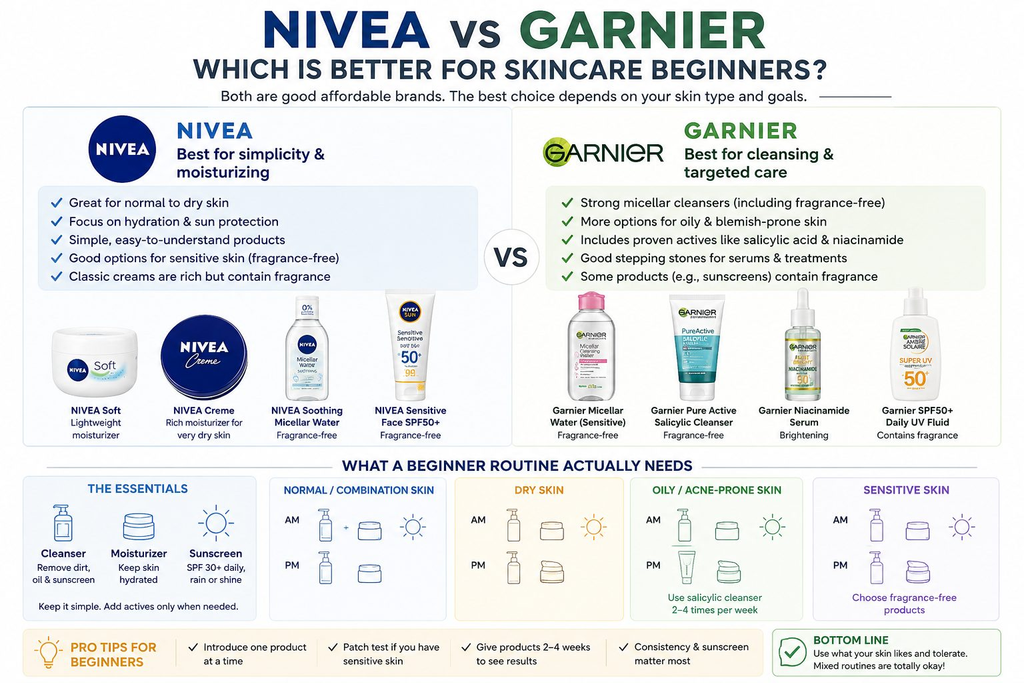
Nivea has an advantage if you want a small, uncomplicated routine built around basic moisturizing and sun protection. Garnier is often the more useful starting point if you want a gentle micellar cleanser, have oily or blemish-prone skin, or want products targeted at concerns such as clogged pores.
There is one important catch: some of Nivea’s best-known products, including Nivea Creme and Nivea Soft, contain fragrance in their current UK formulas. That does not make them bad products, but it means they would not be my first recommendation for someone whose skin is sensitive, reactive, or already irritated. Meanwhile, Garnier also sells fragranced products, so choosing by brand name alone is not enough.
For a beginner, the better strategy is to choose one cleanser, one moisturizer if you need it, and a daily sunscreen, then add treatment products only when you have a specific reason.
The short answer: Nivea or Garnier?
For most beginners, I would divide the decision this way:
| If this sounds like you | Better place to start |
|---|---|
| You want the simplest possible routine | Nivea |
| Your skin is normal to dry and tolerates fragrance | Nivea |
| You want a basic micellar cleanser | Either; Garnier has a particularly strong micellar range |
| Your skin is oily, congested, or mildly blemish-prone | Garnier |
| Your skin is sensitive or easily irritated | Choose individual fragrance-free products from either brand |
| You want to experiment with serums and targeted ingredients later | Garnier offers more obvious stepping stones |
| You mainly want a straightforward high-SPF face sunscreen | Either brand can work |
The important point is that a skincare beginner does not need to commit to one brand. A Garnier cleanser, a moisturizer from another company, and a Nivea sunscreen can make more sense than forcing an all-Nivea or all-Garnier routine.
What a beginner routine actually needs
Before comparing product ranges, it helps to strip skincare back to its essentials.
The American Academy of Dermatology recommends a simple approach based on cleansing, moisturizing, and sun protection. It advises using a gentle cleanser, applying moisturizer as needed—even oily skin can require moisturizer—and choosing sun protection appropriate for daily use.
That means your first routine does not need toner, eye cream, exfoliating pads, sheet masks, multiple serums, face oils, or a complicated night routine.
A sensible starting structure is:
Morning:
Gentle cleanse if necessary → moisturizer if necessary → sunscreen
Evening:
Cleanser → moisturizer
Use that routine consistently for a few weeks before deciding that you need more.
This approach also makes troubleshooting easier. If your face suddenly starts burning, peeling, itching, or breaking out after you introduce six products at the same time, it is difficult to identify which one caused the problem.
Where Nivea makes sense for a beginner
Nivea’s biggest strength is familiarity and simplicity. Many of its mainstream products are designed around moisturizing rather than building elaborate routines around active ingredients.
Nivea Soft: easy to understand, but not ideal for everyone
Nivea Soft is marketed in the UK as a lightweight moisturizer for the face, body, and hands. Its current formula includes glycerin, vitamin E and jojoba oil, and Nivea positions it as quicker-absorbing and lighter than its classic Creme.
For someone with fairly resilient normal or dry skin, that simplicity can be appealing: one inexpensive cream can cover several jobs.
However, the current UK ingredient list also contains parfum and several fragrance components, as well as alcohol denat.
That does not mean everyone should avoid it. Plenty of people tolerate fragranced skincare without difficulty. But if you already know that your face stings easily, becomes red after products, or reacts to scented cosmetics, there are safer places to begin.
The American Academy of Dermatology specifically recommends fragrance-free products when trying to keep a routine gentle, particularly for sensitive skin, because fragrance can trigger irritation or allergic reactions in susceptible people.
What about the classic blue-tin Nivea Creme?
Nivea Creme is richer than Nivea Soft. Nivea describes it as intensive protective care for the face, body, and hands, and its current UK formula includes mineral oil, glycerin, paraffin, panthenol and lanolin alcohol.
For rough hands, elbows, very dry patches, or someone who simply enjoys a heavy cream, that richness can be useful.
As a first facial moisturizer, however, it is not universally ideal.
The formula contains fragrance and several listed fragrance allergens. It is also substantially richer than many dedicated face moisturizers.
That does not make Nivea Creme “pore-clogging” for everyone, nor is it reasonable to declare that it causes acne in every oily-skinned user. Skin response is individual. But if you already have an oily T-zone or frequent breakouts, starting with a lighter facial moisturizer may make it easier to judge what your skin actually needs.
Nivea has gentler products than its famous creams
Judging Nivea entirely by the blue tin would be misleading.
The current Nivea Soothing Micellar Water for Sensitive Skin sold in the UK is perfume-free and contains glycerin and panthenol. Nivea markets it for removing makeup, dirt and SPF without rinsing.
Its current Sensitive facial sunscreen is another more beginner-friendly example. Nivea SUN Breathable UV Face Sensitive SPF50+ is fragrance-free and marketed as non-comedogenic and suitable for sensitive skin.
So Nivea can absolutely form the basis of a gentle routine—you simply need to look beyond the most famous fragranced creams.
Where Garnier is stronger for beginners
Garnier’s skincare range is broader and more treatment-oriented. That can be an advantage if you already know your main problem, but it can also encourage beginners to buy more products than they need.
The best example is cleansing.
Garnier Micellar Water is a very straightforward first cleanser
Garnier’s standard Micellar Cleansing Water for Sensitive Skin is one of the more beginner-friendly products in its current UK range.
Garnier describes the formula as perfume-free and suitable for all skin types, including sensitive skin. Its current ingredient list is relatively short and includes water, glycerin, cleansing agents and panthenol.
It is designed to remove dirt, oil, makeup and SPF without harsh rubbing or rinsing.
That makes it particularly convenient if you wear makeup or sunscreen and want a low-effort evening cleansing step.
You do not necessarily need micellar water, however. A gentle rinse-off facial cleanser is equally reasonable. And if your face feels more comfortable rinsing micellar water away despite the product being designed as no-rinse, there is no prize for following skincare instructions more rigidly than your skin prefers.
Garnier has a clearer option for blemish-prone beginners
Garnier also has an advantage if clogged pores or mild acne are your main concern.
Its current Pure Active Salicylic Purifying Gentle Cleanser contains salicylic acid alongside niacinamide, clay and ceramide-related ingredients, and the formula is fragrance-free.
Salicylic acid is not simply a trendy cosmetic ingredient. The American Academy of Dermatology includes it among established topical options for acne and notes that it helps open clogged pores and exfoliate the skin.
That makes a salicylic cleanser potentially useful for someone dealing with blackheads, whiteheads or mild congestion.
But “potentially useful” is different from “every beginner should use it.”
If you have clear, comfortable skin, there is no reason to introduce an acne active just because it is available. And if salicylic acid makes your skin dry, tight or irritated, using it less frequently or returning to a plain cleanser may be more sensible.
Severe, painful, scarring or persistent acne deserves proper medical assessment rather than an escalating collection of drugstore products.
Which brand is better for sensitive skin?
Neither brand wins automatically.
Sensitive skin is exactly where brand-level comparisons become least useful.
The current UK Nivea Soft and Nivea Creme formulas contain fragrance.
But Nivea also sells a perfume-free sensitive micellar water and a fragrance-free SPF50+ facial sunscreen.
Likewise, Garnier’s standard sensitive micellar water and its Salicylic Purifying Gentle Cleanser are currently perfume/fragrance-free.
Yet Garnier’s current Hyaluron Barrier Protect Daily UV Fluid SPF50+, for example, lists fragrance in its UK ingredients.
So for sensitive skin, do not ask, “Is Garnier gentler than Nivea?”
Ask:
Is this exact cleanser, moisturizer or sunscreen fragrance-free, comfortable on my skin and appropriate for what I need it to do?
Introduce new products one at a time. If you have a history of reactions, testing a small amount before using a product across your whole face is sensible. The AAD similarly recommends gradual introduction and patch testing for people with sensitive skin.
Which brand is better for oily or acne-prone skin?
Here Garnier has a modest advantage because its mainstream facial-care range more clearly incorporates acne-focused ingredients.
A fragrance-free salicylic acid cleanser is a logical option for someone with clogged pores, and Garnier currently offers one.
That does not mean you need Garnier’s entire Pure Active routine.
One of the most common beginner mistakes is stacking a salicylic cleanser, acid toner, blemish serum, exfoliating mask and spot treatment because they all say “for acne.” Irritation can then become a second skin problem on top of the original one.
Start with one acne-focused product at a time.
And do not skip moisturizer just because your face is oily. The AAD specifically notes that moisturizer remains part of basic skin care and can be useful even for oily or acne-prone skin.
Which is better for dry skin?
Nivea has the clearer advantage if what you mainly want is rich moisturization.
Nivea Creme is substantially richer than the lightweight cleansers and targeted treatments that dominate much of Garnier’s facial-care identity, while Nivea Soft offers a lighter middle ground.
The deciding factor is again sensitivity.
If you have dry skin that tolerates fragrance, you may find either cream perfectly adequate.
If your dryness comes with burning, itching, eczema-like patches or frequent irritation, a fragrance-free facial moisturizer may be a better first purchase than either classic Nivea cream.
Persistent cracking, rashes or unexplained irritation should not simply be treated as “dry skin” indefinitely.
Sunscreen matters more than choosing between the brands
If your budget only allows you to be selective in one category, put real thought into sunscreen.
The American Academy of Dermatology recommends sunscreen with SPF 30 or higher, broad-spectrum UVA/UVB protection and water resistance when sun exposure is expected. It also stresses using enough product and reapplying during ongoing outdoor exposure.
Both Nivea and Garnier currently sell facial SPF50+ products.
For example, Nivea’s UK Sensitive Face SPF50+ is fragrance-free and aimed at sensitive skin.
Garnier’s Hyaluron Barrier Protect Daily UV Fluid is SPF50+ and combines sun protection with glycerin, hyaluronic acid and ceramide ingredients, although its current formula also contains fragrance.
The best sunscreen is ultimately one that provides appropriate protection and that you can comfortably apply in sufficient quantity and keep using. Texture, eye sting, finish under makeup and skin sensitivity can matter more in real life than which brand wins a comparison chart.
A sensible beginner routine using either brand
If I were building a routine from these two brands alone, I would keep it deliberately boring at first.
For normal or combination skin
Morning
- Moisturizer only if your skin feels dry
- Facial SPF30+ or SPF50+
Evening
- Gentle cleanser or fragrance-free micellar water
- Light moisturizer
You do not need an active serum yet.
For dry skin
Morning
- Gentle cleanse only if needed
- Moisturizer
- Sunscreen
Evening
- Gentle cleanser
- Richer moisturizer
Nivea may be the more natural place to shop for the moisturizing step, but fragrance-sensitive skin should still look for a fragrance-free option.
For oily or mildly blemish-prone skin
Morning
- Gentle cleanser
- Lightweight moisturizer if needed
- Non-comedogenic sunscreen
Evening
- Salicylic acid cleanser or another gentle acne-focused product
- Lightweight moisturizer
This is where Garnier’s Pure Active salicylic cleanser makes more sense than buying multiple treatment products immediately.
For sensitive skin
Keep the routine shortest of all:
Morning
- Water or a gentle fragrance-free cleanser
- Fragrance-free moisturizer if needed
- Fragrance-free sunscreen
Evening
- Gentle fragrance-free cleanser
- Fragrance-free moisturizer
Nivea’s sensitive micellar water and sensitive facial SPF show that the brand has products fitting this approach; Garnier’s fragrance-free sensitive micellar water is another reasonable option.
Do not buy a whole skincare range just because the products match
Beginners are often sold skincare as a coordinated set: cleanser, toner, serum, day cream, eye cream, night cream and weekly mask.
Your skin does not care whether the bottles match.
The AAD’s basic guidance is much closer to cleanse, moisturize and protect, while limiting unnecessary products can also reduce irritation.
That makes a mixed routine entirely reasonable.
You might prefer Garnier Micellar Water as your cleanser, a simple fragrance-free moisturizer from somewhere else, and Nivea Sensitive SPF as your sunscreen. There is no skincare benefit to replacing one of those products simply because it has a different logo.
So, is Nivea a good starting brand compared with Garnier?
Yes—but choose Nivea for the right reasons.
Nivea is a good beginner brand if you value accessible, straightforward moisturizing products and simple facial sun protection. Its sensitive micellar water and fragrance-free sensitive sunscreen are particularly relevant if you want an uncomplicated routine.
I would be more cautious about automatically making Nivea Soft or the classic Nivea Creme your first facial moisturizer if you have reactive skin, because both current UK formulas contain fragrance.
Garnier is arguably the more versatile starting brand if you want cleansing options or have oily, congested or mildly blemish-prone skin. Its standard sensitive micellar water is perfume-free, and its current salicylic cleanser gives beginners access to a well-established acne ingredient without requiring a complicated routine.
But the strongest beginner routine may use products from both—or from neither exclusively.
Start by learning what your skin needs. Buy fewer products. Introduce them slowly. Wear sunscreen. Once those basics are working, then decide whether your skin actually needs anything more.
Formula note: Product names and ingredient lists can differ by country and change over time. The product examples above were checked against current official Nivea and Garnier pages available during this review in August 2026. Check the ingredient list on the packaging sold in your market before purchasing, particularly if you have known allergies or sensitivities.
Quellen
- American Academy of Dermatology — “Skin care on a budget.” AAD: Skin care on a budget
- American Academy of Dermatology — “A dermatologist’s guide to skincare from growing up to glowing up.” Published October 28, 2025. AAD dermatologist skincare guide
- American Academy of Dermatology — “How to apply sunscreen.” Last updated August 15, 2025. AAD sunscreen guidance
- American Academy of Dermatology — “Acne: Diagnosis and treatment.” Last updated June 19, 2024. AAD acne treatment guidance
- NIVEA UK — “Soft Moisturiser Face Body & Hands.” NIVEA Soft official product page
- NIVEA UK — “Creme Moisturiser Face Body & Hands.” NIVEA Creme official product page
- NIVEA UK — “Soothing Micellar Water for Sensitive Skin.” NIVEA Soothing Micellar Water
- NIVEA UK — “SUN Breathable UV Face Sensitive Sun Cream SPF50+.” NIVEA Sensitive Face SPF50+
- Garnier UK — “Micellar Cleansing Water Sensitive Skin.” Garnier Sensitive Micellar Water
- Garnier UK — “Pure Active Salicylic Purifying Gentle Cleanser.” Garnier Salicylic Purifying Gentle Cleanser
- Garnier UK — “Hyaluron Barrier Protect Daily UV Fluid SPF50+.” Garnier Hyaluron Barrier Protect SPF50+
Also read… Sean Lock’s Wife
Pingback: Oklahoma City Thunder vs San Antonio Spurs Match Player Stats: Complete Breakdown of the 2026 Western Conference Finals - veiwmagazine
Pingback: OnlyWorkMoods Com: What Is OnlyWorkMoods.com, Is It Legit, and What Does the Website Offer? - veiwmagazine